News
How are ozone decomposition catalysts used in ozone tail destruction?
Ozone decomposition catalyst plays a vital role in ozone tail gas treatment. Its core function is to efficiently convert excess ozone emitted in industrial production, medical disinfection, sewage treatment and other processes into harmless oxygen, thereby avoiding ozone from causing harm to the environment and human health. To understand its specific application, it is necessary to start from multiple aspects such as the background of ozone tail gas generation, the working principle of the catalyst and the actual treatment process.
First of all, the generation of ozone tail gas stems from the application of ozone in various scenarios. Ozone is widely used for sterilization, decolorization, oxidation and degradation of pollutants due to its strong oxidizing property, but during use, some incompletely reacted ozone will form tail gas emissions. If these tail gases are released directly, they will cause serious harm - ozone, as a highly irritating gas, will damage the human respiratory tract and eyes, and is also one of the causes of photochemical smog. Therefore, my country clearly stipulates that the concentration of ozone tail gas emissions must be lower than 0.1mg/m³, and must be treated before it can be discharged.
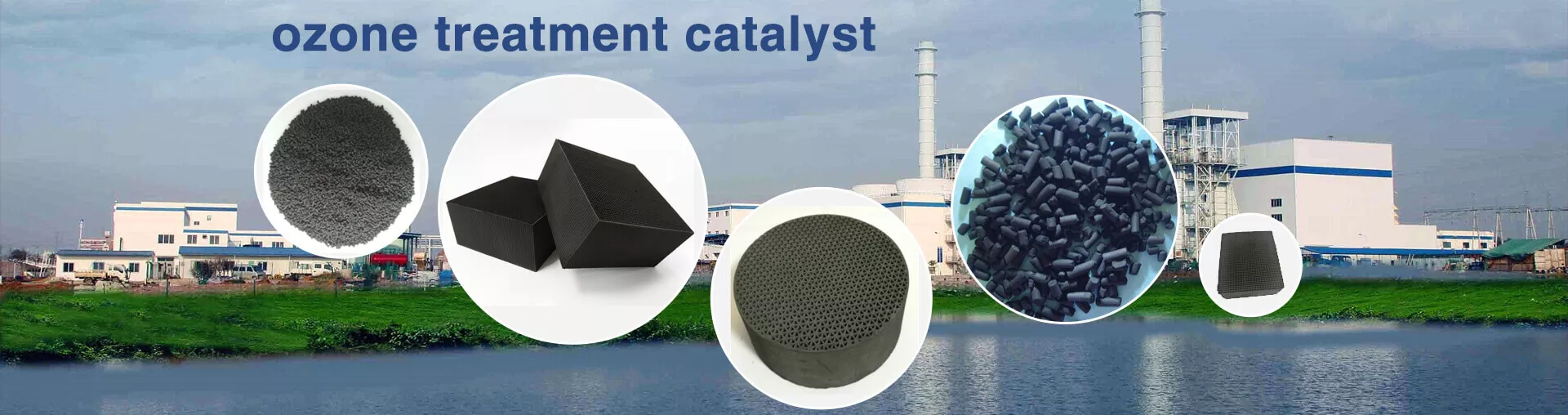
The working principle of ozone decomposition catalyst is based on catalytic reaction. Its core is to reduce the activation energy of ozone decomposition, so that ozone can be quickly converted into oxygen at room temperature or lower temperature. The reaction formula is 2O₃→3O₂. The catalyst participates in the reaction but is not consumed in this process. Common catalyst components are diverse, including metal oxides such as MnO₂, Co₃O₄, Fe₂O₃, etc. This type of catalyst is cost-effective and suitable for most scenarios; precious metals such as Pt, Pd, etc., which are more active but more expensive, suitable for high concentrations or special environments; there are also composite carriers such as activated carbon, alumina, molecular sieves, etc., which are used to increase the specific surface area and stability of the catalyst, thereby enhancing the catalytic effect.
In practical applications, ozone tail gas treatment is a systematic process. First, the tail gas needs to be collected, and the unreacted tail gas in the ozone-generating equipment such as ozone generators, reactors, disinfection chambers, etc. is concentrated through closed pipes to prevent ozone from leaking into the environment. Next, pretreatment may be required, which is not necessary and depends on the composition of the tail gas. If the tail gas contains impurities such as dust, water vapor, acidic or alkaline gases, it needs to be processed first: dust will be removed through filters such as cloth bags and filter screens to avoid clogging the catalyst pores; water vapor will be reduced by drying devices such as dehumidifiers and molecular sieves, because most catalysts will become less active when the humidity exceeds 80%; corrosive gases need to be removed by neutralization devices such as alkaline washing towers to prevent the catalyst from being corroded and ineffective.
After pretreatment, the ozone tail gas enters the core equipment of the catalytic reactor, which is filled with ozone decomposition catalysts. When the tail gas passes through the catalyst layer, the ozone molecules will contact the active sites on the catalyst surface, undergoing the process of adsorption-decomposition-desorption, and finally converted into oxygen. In this process, key parameters need to be controlled, such as the flow rate must match the amount of catalyst to ensure that the exhaust gas has sufficient contact time with the catalyst. Usually, the air velocity is controlled at 1000-10000h⁻¹, that is, the volume of gas processed per hour is 1000-10000 times the volume of the catalyst; in terms of temperature, most catalysts can work at room temperature of 20-40℃, and some low-temperature exhaust gas scenes can be properly heated to 50-100℃ to improve activity; and for ozone concentration, the catalyst is suitable for a range from a few mg/m³ to thousands of mg/m³. At high concentrations, it may be necessary to increase the amount of catalyst or use a multi-stage series reactor.
After catalytic decomposition, the ozone concentration in the exhaust gas drops below the emission standard, usually less than 0.1mg/m³, and can be directly discharged into the atmosphere through the exhaust pipe. However, after long-term use, the catalyst may be deactivated due to impurities covering the active sites. At this time, it can be regenerated by high-temperature heating (200-300℃), purging, etc. If the catalyst is seriously deactivated due to poisoning, sintering, etc., it needs to be replaced regularly. Its service life is usually 1-3 years, depending on the use environment.
In practical applications, there are some key considerations that need to be paid attention to. The selection of catalysts should be determined based on parameters such as ozone concentration, tail gas flow, temperature, humidity, and impurity composition. For example, water-resistant catalysts are suitable for high humidity environments, and precious metal catalysts should be avoided in sulfur-containing environments. The design of the reactor is also very important. Reasonable airflow distribution needs to be adopted, such as using honeycomb catalysts or fluidized bed reactors to ensure that the tail gas is fully in contact with the catalyst to avoid the "short circuit" phenomenon, that is, some gases are discharged directly without passing through the catalyst. At the same time, the outlet ozone concentration should be monitored in real time through an ozone online detector to ensure the treatment effect, and the pressure difference of the catalyst layer should be checked regularly to determine whether blockage occurs.
At present, ozone decomposition catalysts are widely used, including tail gas treatment after ozone oxidation in sewage treatment plants, tail gas emission treatment of ozone disinfection equipment in the medical field, tail gas treatment after ozone as an oxidant in the chemical industry, and tail gas purification after ozone disinfection in food processing workshops, etc. Through such a complete set of processes and operating specifications, ozone decomposition catalysts can efficiently and stably convert ozone tail gas into harmless oxygen, becoming one of the most economical and commonly used ozone tail gas treatment technologies.
 ∷
∷

 minstrong