What is the catalytic process of ozone decomposition?
Simply put, ozone decomposition refers to the efficient and safe conversion of ozone (O₃), an unstable molecule composed of three oxygen atoms, into the common oxygen (O₂) we need for breathing. This process occurs slowly and spontaneously in nature, but in many human-involved scenarios, ozone, as an air pollutant or industrial byproduct, needs to be rapidly and actively reduced in concentration. In these cases, we need to utilize ozone decomposition catalysts to achieve efficient treatment through ozone catalytic decomposition technology.

What is ozone decomposition? What does it rely on to decompose?
Ozone (O₃) is a strong oxidizing gas. In the stratosphere, it acts as a "guardian" of the Earth, but near the ground, it becomes a pollutant that harms human health and the ecological environment. The core objective of ozone decomposition is to break the relatively loose oxygen bonds in the ozone molecule, recombining it into stable oxygen molecules.
This conversion can be achieved through several pathways:
Thermal decomposition: High temperatures (typically above 300°C) can directly destroy ozone molecules, but this is extremely energy-intensive and uneconomical.
Photocatalytic decomposition: Ultraviolet light of specific wavelengths can decompose ozone, but efficiency is limited by equipment and space constraints.
Catalytic decomposition: This is currently the most mainstream and efficient method. It utilizes a heterogeneous catalytic reaction on the catalyst surface, significantly reducing the activation energy of the reaction at room temperature or lower, allowing ozone to decompose rapidly and with low energy consumption. This is the core of the ozone catalytic decomposition technology we are discussing.
Therefore, modern, efficient, and practical ozone decomposition processes primarily rely on the key material of the ozone decomposition catalyst.
Ozone Decomposition Catalyst: The "Heart" of the System

A highly efficient ozone decomposition catalyst is typically a complex micro/nano system, rather than a single substance. Its main components include:
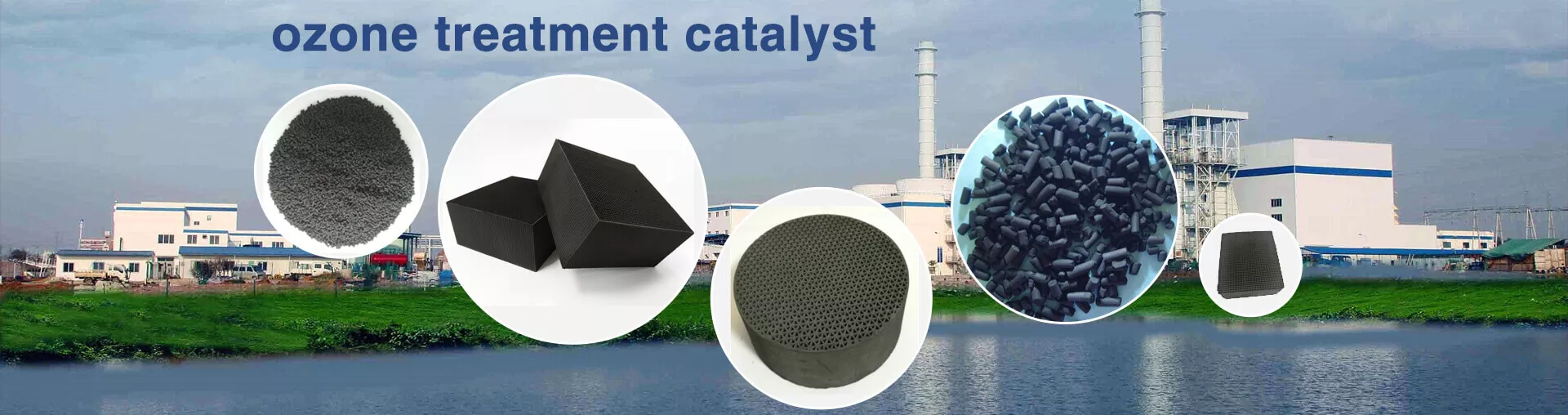
Active Components: These are the direct executors of the catalytic action, usually transition metal oxides such as manganese dioxide (MnO₂), copper oxide (CuO), cerium oxide (CeO₂), and noble metals (such as palladium and platinum). They provide the active sites for the reaction.
Supports: Porous materials such as honeycomb ceramics, activated alumina, and molecular sieves. Their role is to maximize the dispersion surface area of the active components, provide a stable physical structure, and ensure sufficient contact between the gas flow and the catalyst.
Co-catalysts: Components added in small amounts to enhance the activity, selectivity, or stability of the main catalyst.
Unveiling the Catalytic Process: "Disassembly and Recombination" in the Microscopic World
Ozone catalytic decomposition is a typical surface chemical reaction process. Its mechanism can be simplified into the following key steps, constituting a complete catalytic cycle:
Adsorption and Activation: When an ozone-containing gas flow passes over the catalyst surface, ozone molecules are first physically or chemically adsorbed by active sites (such as Mn⁴⁺, oxygen vacancies, etc.). This adsorption stretches and weakens the O-O bonds in the ozone molecules, thus "activating" them and placing them in a state where they are more easily broken.
Surface Decomposition and Atomic Recombination: The activated ozone molecules decompose at the active sites. A typical reaction pathway is as follows: an ozone molecule (O₃) gains an electron from an active site and decomposes into an oxygen molecule (O₂) and an adsorbed active oxygen atom (O). Subsequently, another ozone molecule (O₃) from the gas phase reacts with this active oxygen atom (O) to generate two oxygen molecules (O₂). Alternatively, the two adsorbed active oxygen atoms (O*) directly combine to form an oxygen molecule. The key role of the catalyst is that it provides a perfect "micro-reaction platform" for these reactions, allowing atomic recombination to occur at extremely low energy barriers.
Product desorption and active site regeneration: The generated oxygen molecule (O₂) desorbs from the catalyst surface and is released into the gas stream. Simultaneously, the active sites of the catalyst are "emptied" and restored to their initial state, ready to receive the adsorption of the next ozone molecule. This step ensures that the catalyst can continue to operate without being clogged by products.
The core of the entire ozone decomposition catalytic cycle lies in the catalyst's ability to successfully "pry open" ozone molecules by providing a unique surface electronic environment and geometry, guiding oxygen atoms to reassemble into oxygen in a more energy-efficient manner. In this process, the catalyst itself is not consumed under ideal conditions, achieving continuous catalysis.
Applications and Significance Ozone catalytic decomposition technology based on the above principles has been widely applied in numerous fields: from ozone removal inside office appliances (such as photocopiers and air purifiers), to environmental treatment of industrial waste gases (such as corona discharge treatment and ozone tail gas from water treatment), and to air quality control in special spaces (such as aircraft cabins and subway tunnels). Highly efficient and stable ozone decomposition catalysts are the technological cornerstone for these applications.
In summary, ozone decomposition has evolved from a natural phenomenon into a precisely controllable environmental engineering technology through the intervention of ozone decomposition catalysts. A deep understanding of the microscopic processes of ozone catalytic decomposition not only reveals the wonders of heterogeneous catalysis but is also key to our continuous development of more efficient and stable catalysts to meet the ever-increasing demands for environmental purification.
 ∷
∷

 minstrong