A Brief Analysis of the Disadvantages and Solutions of Ozone Water Treatment
In modern water treatment technology, ozone water treatment is highly favored for its powerful oxidation capacity and efficient sterilization and disinfection effect. It can not only rapidly inactivate bacteria and viruses, but also effectively degrade various organic pollutants, and does not produce secondary pollution residues during the treatment process, making it hailed as one of the ideal alternatives to chlorine disinfection. However, like any technology, ozone water treatment has its two sides, and its practical application has also revealed some significant disadvantages. This article will focus on discussing these technical bottlenecks and propose corresponding solutions, especially the key role played by ozone decomposition catalyst.

I. Main Disadvantages of Ozone Water Treatment
Ozone's Instability and Short Lifespan
Ozone (O₃) is an extremely unstable gas with a very short half-life in water, typically only 20-30 minutes, and is affected by factors such as water temperature and pH value. This characteristic prevents ozone from maintaining its disinfection efficacy in water for extended periods, a fatal weakness for water supply systems requiring long-distance transport or continuous antibacterial action. After leaving the reactor, residual ozone rapidly decomposes, potentially failing to effectively inhibit bacterial regeneration in the pipe network.
Potential Byproducts: When ozone reacts with naturally occurring bromide ions or certain organic compounds in water, harmful byproducts such as bromate, formaldehyde, and aldehydes may be generated. Bromate is listed as a potential carcinogen by the World Health Organization, posing a new challenge to the safety of ozone-treated water.
High Operating Costs and Energy Consumption: On-site ozone production requires significant electrical energy. The equipment investment and maintenance costs of its production systems (such as high-voltage discharge methods) are higher than those of traditional chlorine disinfection processes. This deters some budget-constrained projects from adopting ozone water treatment technology.
Exhaust Gas Treatment and Safety Hazards: During ozone addition, residual ozone that is not absorbed by the water escapes, forming ozone exhaust gas. This exhaust gas is highly irritating and damaging to the human respiratory tract and is also a greenhouse gas. Therefore, proper treatment of exhaust gases is essential, which increases the system's complexity and cost.
II. Core Solutions and Technological Innovations
To address the aforementioned shortcomings, researchers and engineers have developed a series of effective countermeasures.
Optimizing Process Design and Controlling Byproduct Generation
The core of addressing byproduct issues lies in prevention. Pre-treatment processes (such as activated carbon filtration and coagulation sedimentation) to remove bromide ions and precursors from the water can reduce the risk of byproduct formation such as bromate at the source. Simultaneously, precisely controlling ozone dosage, reaction time, and pH value are also key means to optimize the reaction pathway and minimize byproducts.
Using Combined Processes to Compensate for Insufficient Continuity
To solve the problem of poor ozone continuity, one of the most effective methods is to use combined processes. For example, the "ozone-bioactivated carbon" (O₃-BAC) process utilizes ozone to oxidize and decompose large organic molecules into easily biodegradable small molecules, which are then adsorbed and biodegraded by subsequent bioactivated carbon. This combination not only improves overall treatment efficiency but also effectively inhibits bacterial regeneration in the pipeline network through the long-term biological action of bioactivated carbon. In addition, trace amounts of chlorine or chloramine can be added before effluent discharge as an auxiliary disinfectant to ensure the biological stability of the water supply network.
Applying Ozone Decomposition Catalysts to Overcome the Challenges of Exhaust Gas Treatment

The mature application of ozone decomposition catalyst technology represents a major breakthrough in addressing the most dangerous exhaust gas problem. Traditional thermal decomposition methods are energy-intensive, while activated carbon adsorption methods suffer from material saturation and frequent replacement.
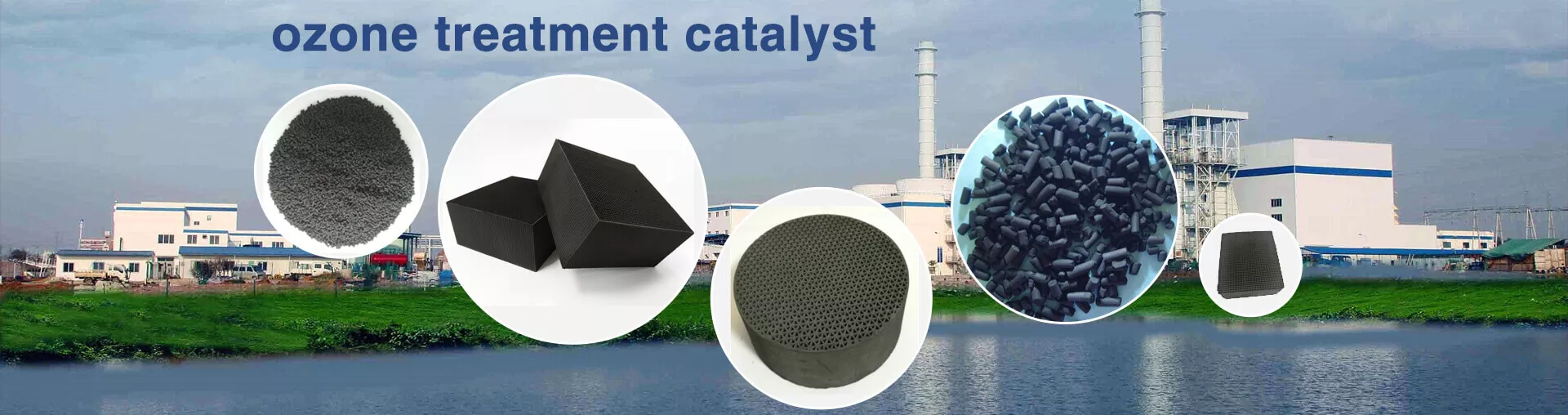
Ozone decomposition catalysts are special materials that can rapidly decompose toxic ozone (O₃) into harmless oxygen (O₂) at room temperature or even low temperatures. Their working principle is that the catalyst surface provides active sites, greatly reducing the activation energy of ozone decomposition, allowing the reaction to be completed efficiently and instantaneously.
Specific advantages include:
High efficiency and safety: It can reduce the ozone concentration in exhaust gas to below safe standards at room temperature, protecting the health of operators and the surrounding environment.
Economical and energy-saving: No additional heating is required, operating energy consumption is extremely low, and the catalyst has a long lifespan, reducing maintenance costs.
Easy Integration: The exhaust gas destruction device equipped with an ozone decomposition catalyst can be directly installed at the exhaust port of the ozone contact tank. The system is compact and easily integrated into existing ozone water treatment processes.
Ozone water treatment technology is undoubtedly a powerful and efficient water purification technology, but we cannot ignore its inherent shortcomings. By optimizing process parameters, adopting combined technologies, and actively introducing innovative solutions such as
ozone decomposition catalyst, we can effectively leverage its strengths and mitigate its weaknesses, addressing challenges in stability, safety, and economy. In the future, with further innovation in catalyst materials and intelligent process control, ozone water treatment will undoubtedly play a safer, more economical, and more reliable role in ensuring drinking water safety and wastewater treatment and reuse.
 ∷
∷

 minstrong