Welcome: Hunan Minstrong Technology Co., Ltd
Language: Chinese ∷  English

Industry new

What Catalysts Can Efficiently Decompose Ozone?

What is Ozone?

Ozone (O₃) is an allotrope of oxygen, a pale blue gas with a distinctive odor at room temperature. Its peculiarity lies in the fact that its concentration and location determine its role—in the stratosphere, the ozone layer acts as Earth's "protective umbrella," effectively absorbing harmful ultraviolet radiation; while near the ground, ozone, with its strong oxidizing properties, harms humans and their environment.

Which type of ozone do we need to decompose?

Industrial ozone mainly originates from deep wastewater treatment processes, excessive ozone emissions from ozone contact tanks, and byproducts from electrostatic copiers, laser printers, and ultraviolet disinfection equipment. Scientific research shows that when indoor ozone concentrations reach 0.20 mg/m³ or higher, they pose serious health risks. The World Health Organization (WHO) has set a safety standard of less than 0.10 ppm (approximately 0.20 mg/m³) in an 8-hour working environment.

Why decompose it?

Ozone not only strongly irritates the respiratory tract, causing various respiratory diseases, but it is also a significant component of photochemical smog. When ozone concentrations exceed 0.20 mg/m³, even short periods of strenuous outdoor exercise can increase the risk of respiratory symptoms and decreased lung function. If left untreated, ozone pollution will continue to threaten the occupational health of employees, the living environment of communities, and even affect the environmental compliance of enterprises. Therefore, the effective elimination of ozone has become a crucial and pressing issue in environmental protection today.

What catalysts can efficiently decompose it?

Currently, methods for treating ozone emissions mainly include activated carbon adsorption, thermal decomposition, electromagnetic radiation, and catalytic decomposition. Among these, catalytic decomposition has received widespread attention due to its advantages such as complete ozone decomposition, regenerable and reusable catalysts, and ease of operation. The following are some mainstream high-efficiency catalysts:

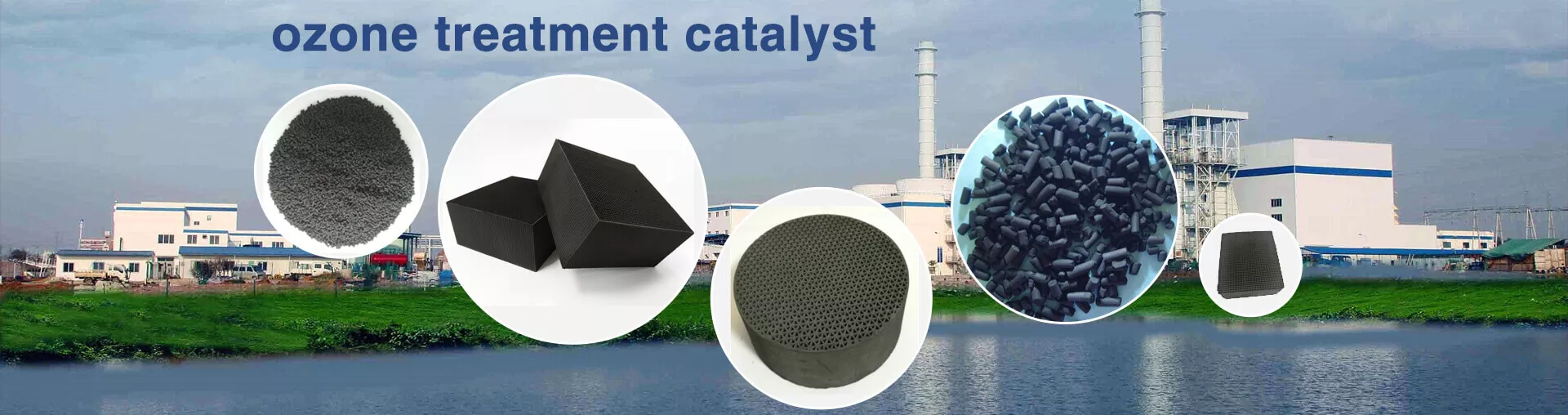
Manganese dioxide (MnO₂) catalyst: An ozone decomposition catalyst developed using the large specific surface area of MnO₂. Its surface has numerous uneven pores, with an average particle size of 0.1~0.5mm and a BET value reaching 150m²/g. It can be used for extended periods.

Copper-manganese composite catalyst: This is one of the most efficient and widely used catalysts for decomposing ozone. The synergistic redox cycle between copper and manganese (Cu⁺/Cu²⁺ and Mn³⁺/Mn⁴⁺) significantly accelerates ozone decomposition, maintaining stable and efficient decomposition capabilities even in high-moisture gases with relative humidity exceeding 80%. Adding a small amount of silver further improves moisture resistance and service life, making it the preferred solution for treating high-humidity conditions, industrial exhaust gases, and ozone disinfection exhaust gases.

Honeycomb ozone decomposition catalyst: Suitable for treating low-concentration, high-volume ozone gases. Easy to install and remove, with low air resistance, widely used in printing plants, high-voltage discharge workshops, and ultraviolet ozone disinfection applications.

Key Performance Indicators of High-Performance Catalysts

Taking a certain brand of ozone decomposition catalyst as an example, its products possess the following key performance parameters: a specific surface area as high as 160~240 m²/g; a large number of microporous structures within the catalyst effectively adsorb ozone and catalytically decompose it; an effective component content of over 80%; stable performance; long lifespan; and minimal loss; the catalyst is heat-resistant, contains no flammable or volatile components, and poses no risk of combustion or secondary pollution when treating high concentrations of ozone.

Why Choose Catalytic Decomposition?

Catalytic decomposition offers significant advantages over traditional technologies: zero energy consumption; no need for frequent activated carbon replacement; extremely high decomposition efficiency, meeting safety and economic requirements; no need for any additional reagents; high activity and a wide space velocity range (0.5~100,000); and low gas flow resistance. A company's independently developed ozone decomposition catalyst can efficiently accelerate the decomposition of ozone into harmless oxygen at room temperature, maintaining a decomposition efficiency consistently above 95%. The ozone concentration in the treated exhaust gas can be reduced to an extremely low level of less than 0.10 ppm. Even under harsh conditions with relative humidity as high as 90%, it maintains high efficiency and stable catalytic activity.

Ozone pollution control is urgent. Whether it's achieving emission standards for industrial exhaust gas, improving workshop air quality, or ensuring a healthy office environment, choosing a suitable high-efficiency ozone decomposition catalyst is the most economical and thorough solution.

Are you looking for a high-efficiency and stable catalyst for ozone control? Contact us for professional technical consultation and customized product solutions. Let's work together to create a clean, safe, and environmentally friendly production and living environment!

Author: kaka

Date: 2026/4/20

CONTACT US

Contact: Candyly

Phone: +8618142685208

Tel: 0086-0731-84115166

Email: sales@minstrong.com

Add: E2 Building, Kinglory Science And Technology Industrial Park, Wangcheng Area, Changsha, Hunan, China.

Scan the qr codeClose
the qr code