News
The Principles of Advanced Oxidation Catalyst Application in Wastewater Treatment Plants
Why is Catalytic Ozone Needed?
Ozone is a powerful oxidant in advanced wastewater treatment. However, using ozone alone presents two major bottlenecks: First, selective oxidation: ozone tends to attack organic compounds containing unsaturated bonds or specific functional groups, resulting in low oxidation efficiency for certain saturated, recalcitrant organic compounds (such as herbicides and some pharmaceuticals); second, low ozone utilization: typically, only a portion of ozone is effectively utilized in the oxidation reaction, while the remainder escapes with exhaust gases, resulting in wasted energy.
To address these issues, heterogeneous catalytic ozone oxidation technology has emerged. Its core lies in the introduction of a solid-state catalyst, which significantly improves the efficiency of ozone decomposition, generating more potent, non-selective hydroxyl radicals (•OH), thereby achieving efficient and thorough degradation of pollutants.
How does manganese dioxide "catalyze" ozone?
Manganese dioxide, an inexpensive, readily available, and environmentally friendly transition metal oxide, catalyzes ozone decomposition primarily due to its unique surface properties and variable valence. The catalytic process can be summarized into two core steps:
1. Ozone Adsorption and Activation on the Catalyst Surface
Manganese dioxide's crystal structure contains abundant oxygen vacancies and exposed Mn³⁺/Mn⁴⁺ active sites. These sites strongly adsorb and activate ozone molecules.
Adsorption and Decomposition: Gaseous or dissolved ozone (O₃) molecules preferentially adsorb on the active sites on the manganese dioxide surface. Due to ozone's instability, the electrons from the Mn ions rapidly decompose each O₃ molecule into an adsorbed oxygen atom and an oxygen molecule.
Forming Surface Active Oxygen Species: The adsorbed oxygen atoms produced by decomposition interact with lattice oxygen or water molecules on the catalyst surface, forming highly reactive surface atomic oxygen or surface hydroxyl groups. These surface active species are themselves strong oxidants that can directly oxidize some organic matter.
2. Chain Reaction Generation of Hydroxyl Radicals (Key Step)
This is the essence of manganese dioxide's catalytic efficiency, which far exceeds that of homogeneous catalysis. It is a chain reaction initiated on the catalyst surface and continuously occurring in the water:
Initiation Phase: Ozone molecules adsorbed on the MnO₂ surface extract an electron from a hydroxyl group or water molecule on the catalyst surface, being reduced to a superoxide radical anion and simultaneously generating the key hydroxyl radical.
O₃ + e⁻ (from the catalyst surface) → O₂•⁻ + •OH
Chain Reaction Propagation: The generated superoxide radicals and hydroxyl radicals further undergo a series of complex reactions with ozone and organic intermediates in the water, generating new free radicals like a domino effect. The most important of these reactions is the continuous generation of more hydroxyl radicals. O₂•⁻ + O₃ → O₂ + O₃•⁻
O₃•⁻ + H⁺ → HO₃• → •OH + O₂
This process causes the rate of free radical generation to increase exponentially, far faster than the decomposition of ozone alone.
Manganese valence cycle: During the reaction, Mn⁴⁺ on the surface of manganese dioxide can act as an electron acceptor and be reduced to Mn³⁺ or even Mn²⁺. The ozone in the solution can then quickly reoxidize the low-valent manganese to Mn⁴⁺. This Mn⁴⁺/Mn³⁺/Mn²⁺ valence cycle greatly promotes electron transfer and serves as the "engine" that keeps the chain reaction going.
Advantages of Manganese Dioxide Catalysts and Their Role in Wastewater Treatment Plants
Based on the aforementioned principles, heterogeneous catalytic ozone oxidation, represented by manganese dioxide, demonstrates significant advantages in wastewater treatment plants:
Greatly Enhanced Oxidation Capacity: By catalytically generating a large number of hydroxyl radicals, it can indiscriminately attack and mineralize most recalcitrant organic matter (such as antibiotics, endocrine disruptors, and dyes), ultimately decomposing them into CO₂ and H₂O.
Improved Ozone Utilization: Reactions on the catalyst surface significantly accelerate the decomposition and conversion of ozone, enabling the same amount of ozone to degrade more pollutants, reducing operating energy consumption and costs.
Wide pH Range: Unlike the Fenton process, which requires strongly acidic conditions, manganese dioxide catalysts maintain high catalytic activity within the neutral or slightly alkaline pH range commonly found in wastewater. This eliminates the need for pH adjustment and simplifies the process flow.
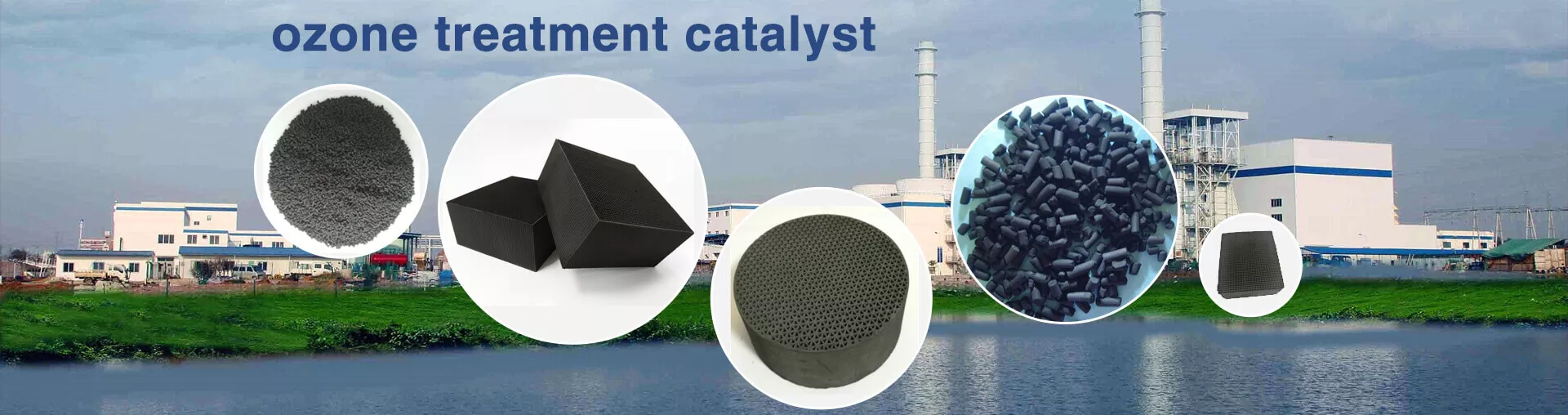
Easy to Separate and Long-Term Stability: As a solid catalyst, manganese dioxide can be loaded onto supports such as alumina, ceramics, and activated carbon, and formed into pellets or honeycomb structures for use in fixed-bed reactors. As water flows through, the catalyst remains intact, ensuring long-term stable operation. This eliminates the need for subsequent separation steps and avoids the secondary contamination caused by iron sludge produced by homogeneous catalysts.
In short, manganese dioxide acts as a highly efficient and tireless "reaction accelerator" and "free radical factory" in heterogeneous catalytic ozone oxidation. Through its surface properties, it adsorbs and activates ozone, initiating and sustaining a vigorous free radical chain reaction, transforming ozone, a selective oxidant, into an indestructible army of hydroxyl radicals. As wastewater treatment plants strive to achieve high-quality effluent standards and address emerging trace pollutants, this technology, with its high efficiency, cost-effectiveness, and environmental friendliness, is becoming an indispensable core tool for advanced treatment and purification.
 ∷
∷

 minstrong