Welcome: Hunan Minstrong Technology Co., Ltd
Language:
 ∷

∷
∷
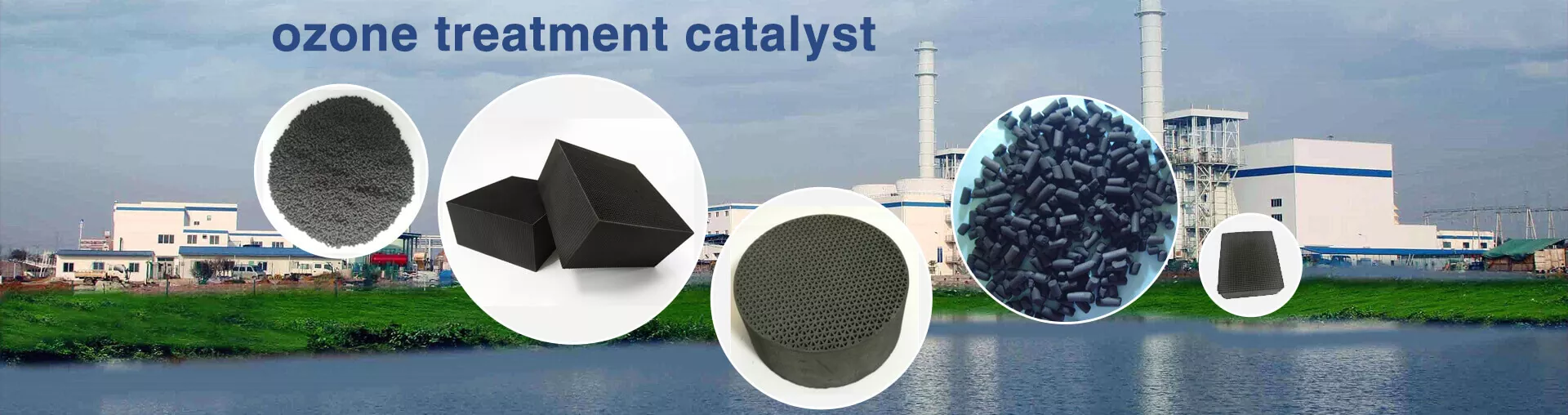
Ozone is used in wastewater treatment for advanced treatment, disinfection, color removal, and the oxidation of certain refractory organic compounds. During contact between ozone and wastewater, not all of the supplied ozone dissolves or reacts with contaminants. Some unused ozone leaves the contact tank with the off-gas.
Because ozone is a strong oxidizing agent, untreated ozone-containing off-gas may pose an exposure risk to personnel and affect the surrounding working environment. Ozone treatment systems therefore generally require off-gas collection and decomposition facilities appropriate to the process scale and operating conditions.
The primary function of an ozone decomposition catalyst is to promote the conversion of residual ozone in the off-gas into oxygen, thereby reducing the ozone concentration in the exhaust stream. This is a gas-phase treatment step and should be distinguished from the oxidation and removal of pollutants in wastewater.
An ozone decomposition catalyst provides an active surface that promotes ozone decomposition. The overall reaction can be expressed as follows:
2O3 → 3O2
The catalyst facilitates the reaction by lowering its kinetic barrier and is not consumed as a net reactant in the overall reaction. The actual reaction pathway and decomposition rate depend on catalyst surface properties, mass transfer, gas humidity, temperature, and other operating conditions.
Industrial ozone decomposition materials may use different metal or metal oxide systems. Copper-manganese composite oxides, for example, can be used in catalytic off-gas treatment systems designed for suitable operating conditions. Their practical suitability must be evaluated against inlet ozone concentration, gas humidity, temperature, contact time, and the required outlet ozone concentration. The material name alone is not sufficient to predict treatment performance.
In a typical ozone off-gas treatment process, the catalyst is installed in a gas-phase treatment unit downstream of the ozone contact tank. After collection and any necessary pretreatment, the off-gas passes through the catalyst bed, where residual ozone decomposes. The treated gas is then monitored and discharged in accordance with the system design and applicable requirements.
| Process Stage | Primary Function | Key Engineering Considerations |
|---|---|---|
| Ozone contact tank | Provides contact between ozone and wastewater for oxidation reactions | Off-gas generation and residual ozone load |
| Off-gas collection system | Collects gas containing residual ozone | System containment, gas flow rate, and flow distribution |
| Pretreatment unit | Removes entrained droplets, foam, or particles when necessary | Condensate drainage, mist removal, and blockage risks |
| Catalytic decomposition unit | Promotes the decomposition of residual ozone | Catalyst loading, contact time, and bed pressure drop |
| Outlet monitoring and discharge | Evaluates treatment performance and supports compliant discharge | Outlet ozone concentration and applicable discharge requirements |
This is a representative engineering configuration rather than a universal equipment arrangement. The actual sequence should be determined by off-gas temperature and humidity, condensate management, fan configuration, and discharge requirements. A mist eliminator or other pretreatment equipment may be installed upstream of the catalyst when needed to reduce the risk of liquid droplets, foam, and particulate matter entering the catalyst bed.
The catalytic decomposition unit should be designed to accommodate the expected off-gas load, including the maximum design load within the intended operating range. The inlet ozone concentration determines the ozone load, while the gas flow rate affects the velocity through the catalyst bed and the available contact time. These factors must be evaluated together. Catalyst selection should not be based solely on the rated ozone generator capacity or the mass of catalyst required.
Off-gas from wastewater treatment plants may have high humidity. If condensation occurs inside the equipment, liquid water may cover catalyst surfaces or interfere with gas flow through the bed, reducing treatment performance. Gas dew point, equipment temperature, and operating conditions should therefore be assessed to determine whether dehumidification, condensate drainage, or temperature control is necessary.
Catalyst particle size, bed height, packing uniformity, and gas distribution affect both pressure drop and contact between the gas and catalyst. Chemical substances carried over in the off-gas may also interfere with catalytic activity. The actual gas composition should be investigated during catalyst selection, and material compatibility should be confirmed through appropriate testing or technical validation.
During operation, inlet and outlet ozone concentrations, catalyst bed pressure drop, gas temperature, and humidity should be monitored and recorded periodically. If the outlet ozone concentration gradually increases, possible causes include changes in inlet loading, poor gas distribution, condensate accumulation, bed blockage, or changes in catalyst activity. An increase in outlet ozone concentration does not automatically mean that the catalyst has reached the end of its service life.
If the bed pressure drop increases significantly, operators should first investigate entrained droplets, particulate accumulation, and restricted gas passages. If the pressure drop remains normal but ozone decomposition performance deteriorates, the actual operating conditions and catalyst condition should be examined further. Whether the catalyst can be cleaned, regenerated, or must be replaced depends on its material properties and verified recovery performance.
Appropriate ozone monitoring, ventilation, and interlock protection should also be incorporated into the system where required. Meeting the target ozone concentration at the catalyst outlet does not necessarily eliminate the risk of ozone leakage in surrounding areas. Off-gas treatment and workplace ozone monitoring should therefore be managed as separate but complementary safety measures.
Successful application of ozone decomposition catalysts in wastewater treatment plants requires more than selecting a material with ozone decomposition activity. Effective off-gas collection, appropriate pretreatment, a catalyst bed designed for the actual operating load, and continuous performance monitoring are also essential. Evaluating catalyst performance in relation to gas flow, ozone concentration, humidity, temperature, pressure drop, and maintenance requirements provides a more reliable basis for controlling residual ozone and maintaining stable operation of the ozone treatment system.
author:kaka
date:2026/10/28
Contact: Candyly
Phone: +8618142685208
Tel: 0086-0731-84115166
Email: sales@minstrong.com
Add: E2 Building, Kinglory Science And Technology Industrial Park, Wangcheng Area, Changsha, Hunan, China.
 minstrong