Welcome: Hunan Minstrong Technology Co., Ltd
Language:
 ∷
∷

∷
∷
Ozone, as a strong oxidizing gas, needs to
be efficiently removed in industrial waste gas, indoor air purification, and
water treatment. Ozone destruction catalyst are the core materials for
achieving this goal. They convert ozone into non-toxic and harmless oxygen through
catalytic decomposition reactions, offering advantages such as high efficiency,
low energy consumption, and no secondary pollution. They are widely used in
chemical, electronics, medical, and automotive exhaust treatment industries.
The following is a professional analysis from two aspects: catalyst types and
core working conditions.
I. Main Types and Characteristics of Ozone Destruction Catalyst
1. Noble Metal Catalysts
Core Components: Platinum (Pt), palladium (Pd), gold (Au), etc., are used as active components. The supports are mostly alumina (Al₂O₃), titanium dioxide (TiO₂), or honeycomb ceramics.
Characteristics: Extremely high catalytic activity, achieving efficient ozone decomposition even at low temperatures (room temperature - 100℃), suitable for low-concentration ozone scenarios (such as indoor air purification and electronics factory exhaust gas treatment); however, it is costly and sensitive to toxic and harmful substances such as sulfur and chlorine, easily suffering poisoning and deactivation.
2. Transition Metal Oxide Catalysts
Core Components: Active components include
copper oxide (CuO), manganese dioxide (MnO₂), iron oxide (Fe₂O₃), and cobalt
oxide (Co₃O₄). Supports can be activated carbon, molecular sieves, ceramic
fibers, etc.
Characteristics: Moderate cost, high cost-effectiveness, suitable for medium-to-high concentration ozone scenarios (such as industrial exhaust gas treatment and ozone generator tail gas purification); some components (such as CuO-MnO₂ composite oxides) have wide temperature range activity and superior resistance to poisoning compared to precious metal catalysts, making it the most widely used type in industrial applications.
3. Composite Oxide Catalysts
Core Components: Composed of two or more transition metal oxides (e.g., CuO-MnO₂-Al₂O₃, ZnO-TiO₂), enhancing catalytic performance through synergistic effects of the components.
Characteristics: Combines the advantages of single oxides, with a wider activity temperature range (-20℃-300℃), stable decomposition efficiency, strong resistance to humidity and impurity interference, and suitable for complex operating conditions (e.g., high-humidity industrial waste gas, ozone tail gas containing trace pollutants).
II. Core Operating Conditions of Ozone Destruction Catalysts
1. Temperature Conditions
Suitable Temperature Range: The optimal
operating temperature for most catalysts is 20℃-200℃. At low
temperatures (<10℃), catalyst activity decreases, and ozone decomposition efficiency
declines; at high temperatures (>300℃), some catalysts
(e.g., MnO₂-based) may undergo crystal transformation, leading to the loss of
active components and shortening catalyst life with long-term use.
Special Scenario Adaptation: For low-temperature environments (such as outdoor exhaust gas treatment in winter), precious metal catalysts or low-temperature composite oxide catalysts can be used; for high-temperature conditions (such as industrial furnace exhaust gas), catalysts supported on high-temperature resistant carriers (such as cordierite honeycomb ceramics) should be selected.
2. Humidity Conditions
Suitable Humidity Range: The optimal range
is relative humidity (RH) of 30%-70%. When humidity is too low (<20%), the
catalyst surface lacks the necessary adsorbed water film, reducing the number
of reactive sites; when humidity is too high (>80%), ozone easily combines
with water to form hydroxyl radicals, and water accumulation may occur on the
catalyst surface, clogging pores, affecting gas diffusion, and reducing decomposition
efficiency.
High Humidity Adaptation Solution: Use hydrophobic carriers (such as modified activated carbon, fluoride-coated carriers) or composite catalysts with added hydrophobic components (such as polytetrafluoroethylene) to avoid the inhibition of catalytic performance by moisture.
3. Gas Space Velocity (GHSV)
Definition: The volume of gas passing
through a unit volume of catalyst per unit time; a key parameter for measuring
the catalyst's processing capacity.
Suitable space velocity range: Typically 10,000-50,000 h⁻¹ in industrial applications. Too low a space velocity results in excessively long contact time between the gas and catalyst, leading to high decomposition efficiency but also excessively large equipment size and increased investment costs. Too high a space velocity (>60,000 h⁻¹) results in insufficient contact between the gas and catalyst, causing ozone to be discharged before complete decomposition, leading to substandard treatment results.
Selection principles: For high-concentration ozone (>1000 ppm), the space velocity should be reduced (10,000-30,000 h⁻¹); for low-concentration ozone (<100 ppm), the space velocity can be increased (30,000-50,000 h⁻¹), balancing treatment efficiency and equipment compactness.
4. Initial Ozone Concentration
Suitable concentration range: The catalyst
has a wide adaptability to ozone concentrations, typically capable of treating
ozone gas concentrations from 1 ppm to 10,000 ppm. For low-concentration
(<100 ppm) scenarios (such as indoor air purification), precious metal
catalysts or low-load transition metal oxide catalysts are sufficient. For
medium-to-high concentration (>1000 ppm) scenarios (such as ozone generator
exhaust gas and chemical oxidation process waste gas), composite oxide catalysts
with high active component loadings are required to ensure complete ozone
decomposition.
Concentration Fluctuation Handling: Ozone concentrations may fluctuate in industrial settings. Stable catalysts and concentration monitoring devices must be selected. When the concentration exceeds the design threshold, adjustments can be made by changing the space velocity or temperature.
5. Raw Material Gas Purity Requirements
Impurity Control: The raw material gas must
avoid toxic and harmful substances such as sulfur compounds (e.g., SO₂, H₂S),
chlorinated hydrocarbons (e.g., Cl₂, CH₃Cl), and heavy metal ions. These
substances can react chemically with the active components of the catalyst
(e.g., sulfidation, chlorination), leading to catalyst poisoning and deactivation.
Simultaneously, particulate matter such as dust and oil mist must be removed to
prevent clogging of catalyst pores.
Pretreatment Measures: High-impurity gases must first pass through pretreatment devices (such as desulfurization towers, activated carbon adsorbers, and HEPA filters) to remove harmful impurities and particulate matter before entering the catalytic decomposition system.
6. Catalyst Bed Design
Bed Height and Pressure Drop: The bed
height is typically 50-200 mm, ensuring uniform gas distribution and avoiding
channeling. Simultaneously, the bed pressure drop must be controlled (generally
< 5 kPa) to reduce fan energy consumption.
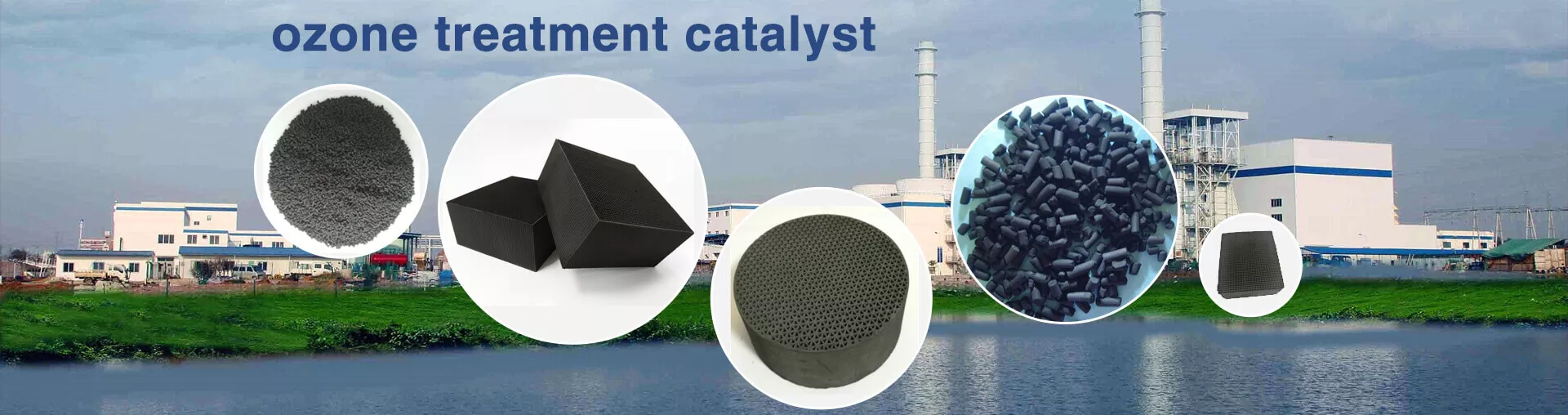
Carrier Morphology Selection: Honeycomb carriers have a large specific surface area and low pressure drop, suitable for high-flow-rate gas treatment; particulate carriers (particle size 3-5 mm) have high contact efficiency, suitable for low-flow-rate, high-concentration scenarios; plate carriers have a compact structure, are easy to disassemble and replace, and are suitable for space-constrained conditions.
The performance of ozone decomposition catalysts is closely related to the catalyst type and operating conditions. In practical applications, it is necessary to select an appropriate catalyst type based on operating parameters such as ozone concentration, gas flow rate, temperature, humidity, and impurity content, and optimize operating conditions such as temperature, space velocity, and bed design to achieve efficient and stable ozone decomposition. For complex operating conditions (such as high humidity, high impurities, and large concentration fluctuations), it is recommended to use composite oxide catalysts, along with a complete pretreatment system and operating condition monitoring device, to ensure that the catalytic decomposition effect meets the standards and to extend the service life of the catalyst.
Contact: Candyly
Phone: +8618142685208
Tel: 0086-0731-84115166
Email: sales@minstrong.com
Add: E2 Building, Kinglory Science And Technology Industrial Park, Wangcheng Area, Changsha, Hunan, China.
 minstrong