Industry new
How is Ozone Oxidation Applied in Wastewater Treatment Plants?
Ozone oxidation technology is a key "weapon" for achieving advanced purification in modern wastewater treatment plants, especially effective in removing recalcitrant pollutants. This article will provide a systematic analysis of this technology.
I) What is Ozone Oxidation Technology?
Ozone oxidation technology is an advanced oxidation technology that utilizes the strong oxidizing properties of ozone to decompose pollutants in water. Its core function involves two pathways:
1. Direct oxidation: Ozone molecules directly attack organic molecules.
2. Indirect oxidation (more crucial): Under the action of catalysts, ozone decomposes to produce highly reactive hydroxyl radicals. These radicals can almost indiscriminately "shred" most organic pollutant molecules, ultimately converting them into carbon dioxide, water, and inorganic salts.
II) How is it Applied in Wastewater Treatment Plants?
Its application scenarios mainly revolve around four goals, usually in series between "biological treatment" and "final effluent or reuse":
Advanced treatment and removal of trace pollutants: Specifically removes residual drugs, pesticides, endocrine disruptors, and other emerging pollutants.
High-efficiency disinfection: Replaces chlorine disinfection, rapidly inactivating bacteria and viruses without producing harmful chlorinated byproducts.
Industrial wastewater pretreatment and biodegradability improvement: Breaks down large, recalcitrant organic molecules into smaller, easily degradable substances, improving the efficiency of subsequent biological treatment.
Decolorization and deodorization: Efficiently destroys chromophores in dyeing wastewater and molecules that cause odors.
Because the efficiency of simple ozone oxidation is limited, catalytic ozone oxidation technology is often used in practical engineering to significantly improve treatment effects by adding catalysts. Depending on the treatment needs and wastewater characteristics, wastewater treatment plants usually use it as an advanced treatment step, placed after biological treatment.
III) Key "Accelerator": Catalysts
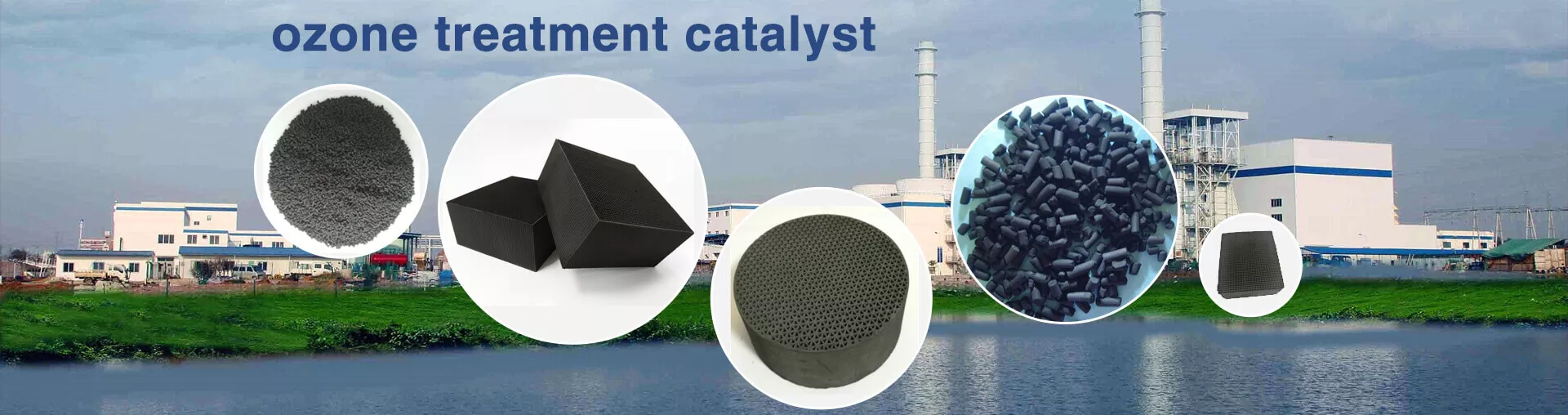
When ozone is used alone, its oxidation efficiency and economic viability are limited. Therefore, catalytic ozone oxidation technology is widely used in engineering to improve efficiency. Catalysts are mainly divided into two categories:
1. Metal (oxide) catalysts: Supported catalysts: such as MnO₂, Fe₂O₃, CuO supported on Al₂O₃, ceramic particles, etc. Homogeneous catalysts: such as Fe²⁺ and Mn²⁺ (requiring subsequent separation). These catalyze ozone decomposition to produce active free radicals through changes in metal ion valence. Heterogeneous catalysts are easy to recover and have good stability. They are suitable for the pretreatment of high-concentration, difficult-to-degrade industrial wastewater (such as chemical and pharmaceutical wastewater).
2. Carbon-based catalysts: activated carbon, carbon nanotubes, modified biochar, graphene, etc. They rely on a huge specific surface area to adsorb and concentrate pollutants, while surface functional groups catalyze the ozone reaction, forming a synergistic effect. Suitable for advanced treatment of municipal wastewater, commonly used as filter media in biological activated carbon filters to achieve integrated "oxidation-biodegradation".
The current research frontier is the development of efficient, stable, and reusable heterogeneous catalysts (such as specific crystalline metal oxides) to reduce operating costs and avoid secondary pollution.
IV) Actual Treatment Effects
After introducing the catalytic ozone oxidation unit, wastewater treatment plants can achieve significant improvements in the following aspects:
1. Deep removal of pollutants: It can stably reduce the COD of secondary effluent from 60-100 mg/L to below 30 mg/L (meeting Class IV or stricter standards for surface water), and the removal rate of specific difficult-to-degrade organic matter can reach 80%-95%.
2. Thorough and safe disinfection: The inactivation efficiency of chlorine-resistant pathogens such as Cryptosporidium is far superior to chlorine disinfection, and it does not produce "carcinogenic, mutagenic, or teratogenic" byproducts.
3. Significant improvement in sensory indicators: The removal rate of color is usually over 90%, and it can effectively eliminate musty and earthy odors.
4. Ensuring the safety of reclaimed water: It is a core technology for achieving high-quality reuse of wastewater for landscape environments, industrial cooling, and even indirect replenishment of drinking water sources, effectively controlling the risks of emerging pollutants.
In short, ozone oxidation technology (especially catalytic ozone oxidation) is a core technological lever for wastewater treatment plants to move from "compliance discharge" to "high-quality reuse" and "ecologically safe discharge". It acts like a precise "chemical scalpel," specifically addressing the remaining problems after biological treatment. In the future, this technology is developing towards lower energy consumption, higher catalytic efficiency, and more intelligent control.
 ∷
∷

 minstrong