Industry new
How are ozone decomposition catalysts applied in wastewater treatment plants?
Why do wastewater treatment plants actively decompose ozone?
Many people believe that ozone, as a powerful disinfectant and oxidant, is added to wastewater to purify the water. This understanding is correct, but the story doesn't end there. The residual ozone in the treated exhaust gas is not a "hero," but rather a "pollutant" that needs to be removed. This is mainly based on the following three key reasons:
Rigid requirements for health and safety: Even at low concentrations (>0.1 ppm), ozone has a distinct fishy odor and a strong irritant effect on the respiratory tract. Long-term exposure can damage human health, causing symptoms such as headaches and chest tightness. Wastewater treatment plants are open or semi-open environments; if ozone-containing exhaust gas is directly emitted, it will pose a serious threat to the health of on-site workers. Therefore, from the perspective of occupational health and safety management, the ozone in the exhaust gas must be completely decomposed.
Legal pressure for environmental protection and compliance with emission standards: Ozone itself is a greenhouse gas and a precursor to photochemical smog. Untreated ozone released into the atmosphere participates in complex photochemical reactions, exacerbating regional air pollution. With increasingly stringent environmental regulations, the supervision of both fugitive and organized emissions from wastewater treatment plants is becoming more detailed, ensuring that exhaust gas meets emission standards has become a fundamental prerequisite for the legal and compliant operation of wastewater treatment plants.
Ensuring Equipment Safety and Stable Operation: Ozone has extremely strong oxidizing properties. Residual ozone will cause slow and continuous corrosion to metal equipment components such as pipes, fans, and instruments that come into contact with it, shortening equipment lifespan, increasing maintenance costs, and creating safety hazards. In particular, if the impeller of a fan used to extract exhaust gas is corroded, it may lead to dynamic imbalance and cause serious accidents. Therefore, ozone decomposition is a necessary measure to protect downstream process facilities and ensure the stable operation of the entire plant.
How are ozone decomposition catalysts applied?
To solve the above problems, ozone decomposition catalysts are precisely applied to the exhaust gas treatment system of wastewater treatment plants. Their application is not in the main wastewater treatment process, but in the auxiliary exhaust gas treatment stage.
Core Application Location and Method:
During operation of ozone catalytic oxidation process units (such as ozone contact tanks), exhaust gas containing unreacted ozone accumulates on the water surface. This exhaust gas is captured by a closed collection system and piped to a specialized exhaust gas destroyer (or ozone exhaust gas decomposition device).
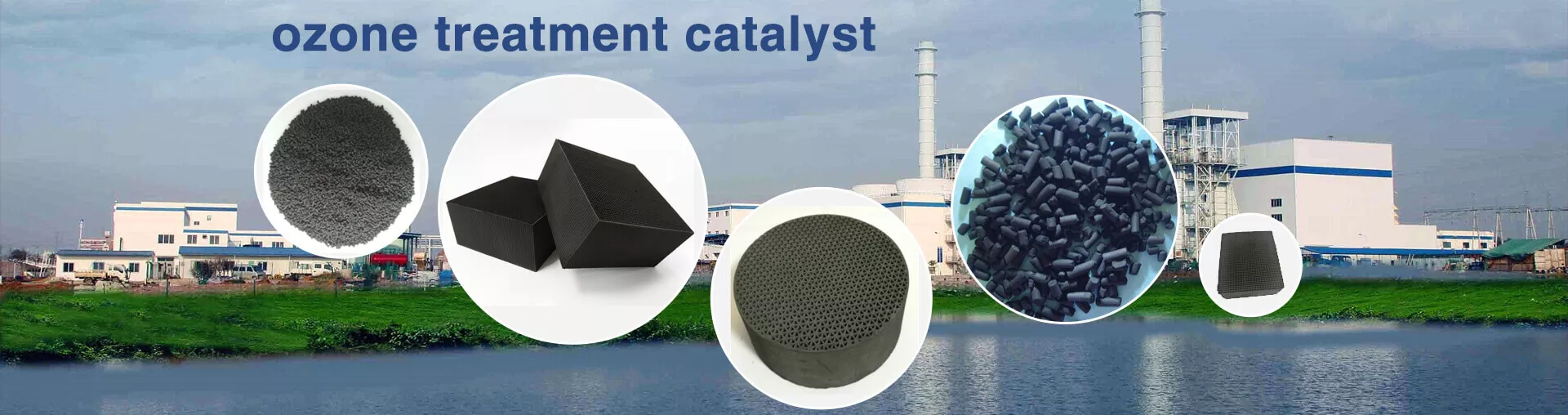
Inside this device, the core material—an ozone decomposition catalyst—is packed. This catalyst typically uses manganese dioxide (MnO₂) as the main active component, supported on an alumina carrier or metal honeycomb ceramic, forming a large specific surface area. When the ozone-containing exhaust gas passes through the catalyst bed driven by a blower, the following highly efficient reaction occurs at the active sites on the catalyst surface: 2O₃ → 3O₂. Under the action of the catalyst, this reaction can rapidly and completely decompose toxic ozone (O₃) into harmless oxygen (O₂) at room temperature or under relatively low heating conditions (depending on the catalyst performance), with a decomposition efficiency typically exceeding 99%.
Key Technological Advantages:
Compared to traditional thermal decomposition methods (requiring temperatures above 350℃ and consuming enormous amounts of energy), catalytic decomposition offers significant advantages such as room-temperature operation, extremely low energy consumption, high decomposition efficiency, and long service life. Catalysts typically operate stably for 1-3 years or even longer before needing replacement, making the entire exhaust gas treatment process both economical and efficient.
In summary, ozone is a double-edged sword in wastewater treatment plants. It is a powerful tool for purifying pollutants in water, but in the air, it becomes a target that needs to be removed. Ozone decomposition catalysts, through their efficient and energy-saving application in exhaust gas treatment systems, successfully resolve this contradiction, ensuring that wastewater treatment plants can achieve environmentally friendly, safe, and reliable full compliance operations while improving effluent quality.
 ∷
∷

 minstrong