Industry new
Composition and Advantages of Ozone Decomposition Catalysts
Ozone decomposition catalysts play a crucial role in environmental management and air purification. They efficiently and precisely convert harmful ozone (O₃) into harmless oxygen (O₂) under mild conditions. Their core technology lies in their unique component design, which yields a series of significant advantages.
I. Core Components: The Art of Synergy
Ozone decomposition catalysts are not composed of a single substance, but rather a sophisticated system of highly active components and a multifunctional support working together. Their main components can be divided into two categories:
1. Transition Metal Oxide Systems
This is currently the most technologically mature and widely used system, renowned for its excellent cost-effectiveness and reliable performance.
Active Components: Oxides of transition metals such as manganese (Mn), copper (Cu), cobalt (Co), and iron (Fe) serve as catalytic active centers. Manganese dioxide (MnO₂) is considered a star material for ozone decomposition, exhibiting extremely high intrinsic activity. Modern catalysts often utilize composite metal oxides (such as Mn-Cu-O and Mn-Co-O). These achieve a "1+1>2" catalytic performance through electronic synergy and structural effects between different metals, demonstrating exceptional performance in terms of reaction rate enhancement and environmental resistance.
Support: Active components are typically supported on porous materials, which serve far more than a simple support.
High surface area provides a reaction platform: Materials such as activated alumina (γ-Al₂O₃) and molecular sieves possess a vast internal surface area, enabling highly dispersed active components and exposing numerous reaction sites.
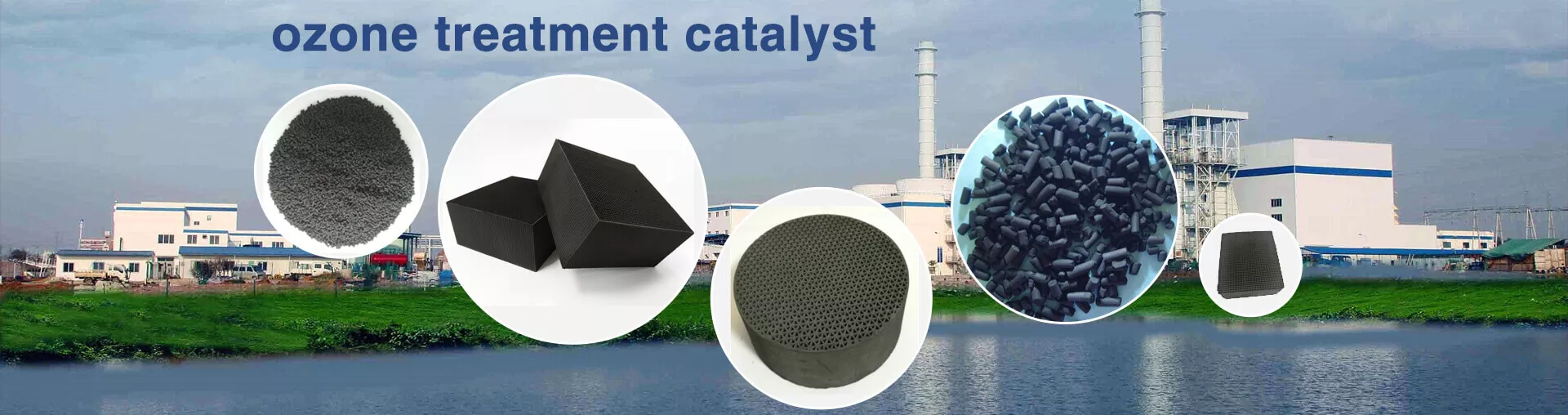
Optimization of structure and function: Honeycomb ceramic supports (such as cordierite) form regular pores with low air resistance, making them suitable for high-volume applications. Activated carbon supports, on the other hand, offer both adsorption and catalytic properties.
2. Precious Metal Systems: These catalysts utilize precious metal nanoparticles such as palladium (Pd), platinum (Pt), and gold (Au) as active centers.
Advantages: They typically exhibit excellent low-temperature activation speed and initial decomposition efficiency, along with long lifespan and high stability.
Challenges: Their greatest limitations lie in their high cost and reliance on scarce resources. Consequently, they are primarily used in specialized applications with extreme performance requirements or demanding conditions.
II. Intrinsic Advantages: Rooted in Composition, Beyond Conventional Methods
Precisely due to this sophisticated component design, ozone decomposition catalysts exhibit multiple decisive advantages over traditional technologies such as adsorption and thermal decomposition:
1. High Efficiency and High Selectivity
The core value of the catalyst lies in its catalytic action, which significantly reduces the energy barrier required for ozone decomposition, enabling instantaneous conversion at room temperature (0-40°C) with an efficiency easily exceeding 99%. Furthermore, the catalyst possesses a unique ability to "recognize" ozone molecules, accurately targeting and decomposing them while remaining virtually unaffected by the presence of abundant nitrogen, oxygen, carbon dioxide, and other molecules in the air, ensuring operational efficiency in complex environments.
2. Intrinsically Safe and Environmentally Friendly
The entire decomposition process is a pure catalytic redox reaction. The only end product is oxygen, with no secondary pollutants produced and no additional chemical reagents required. This is a green process that "turns harm into benefit," fundamentally eliminating desorption pollution or waste disposal problems that can arise after activated carbon saturates with adsorption.
3. Long-Term Economic Benefits and Low Operating Costs
The catalyst acts as a "matchmaker" in the reaction and is self-perpetuating, theoretically offering a permanent lifespan. In practice, its lifespan is only limited by physical clogging or poisoning (e.g., contamination by sulfides or silicates), and it can operate for years in a clean air environment. This means that after a one-time investment, long-term operating costs are extremely low, requiring only a small amount of electricity to overcome system wind resistance. This is far less than thermal decomposition methods that require frequent replacement of adsorbent materials or continuous heating.
4. Low Energy Consumption and Versatility
Another key advantage of this method is its ambient operating mechanism, eliminating reliance on additional energy sources (such as heating), making its integrated applications extremely flexible. Whether it's a power-constrained portable device or a large air duct requiring 24/7 operation, it easily handles the task, significantly expanding the technical applicability.
In summary, ozone decomposition catalysts, through their carefully designed active components and carriers, achieve efficient and precise attack on ozone at the molecular level. Their safety, environmental friendliness, cost-effectiveness, and high efficiency make them an ideal and indispensable technology for addressing ozone pollution. Their value is becoming increasingly prominent as people's demands for air quality rise.
 ∷
∷

 minstrong